


No products in the cart.
Industry News
How to Make Bamboo Basket Step by Step: A Beginner Guide
31
Aug
Aug
A bamboo basket looks like it should be complicated. It is not. Strip the process down and there are only four things happening: you cut bamboo into strips, you lay some of those strips into a flat base, you bend them upward and weave more strips around them, and you lock the top edge with a rim. A first attempt takes an afternoon and comes out slightly wonky, which is exactly how everybody’s first one comes out. This walks through how to make bamboo basket construction from a raw pole to a finished rim.
What You Need Before You Start
Almost nothing here is specialist, and you can substitute your way through most of it.
Tools
A sharp knife with a fairly heavy blade for splitting, a smaller knife for shaving, secateurs or a saw for cutting the pole to length, and a bucket of water. A mallet helps for starting a split on a thick pole. That is genuinely the whole list. Bamboo work is one of the few crafts where the traditional toolkit is still the practical one.
The Bamboo Itself
One pole of 60 to 90 millimetres diameter makes a decent sized basket. If you are cutting your own, choose a pole with straight, even growth, because a visible twist becomes an impossible split later. If you are buying, pre split bamboo strips are sold for craft use and skip the hardest part of the job entirely, which is a sensible way to make a first basket while you learn the weaving.
How to Make a Bamboo Basket Step by Step
Five steps, in order. The first two prepare the material and take most of the day. The last three are the weaving, and they go faster than you expect.
Step 1: Cut and Split the Pole
Cut the pole into sections about a metre long. Longer becomes unwieldy to split, shorter limits how big a basket you can make, and cutting just above a node gives each section a closed end to hold. Then stand it on end, set the knife across the middle of the diameter, and tap it through with the mallet to halve the tube. Halve each half, and keep halving until the strips are roughly one to two centimetres wide.
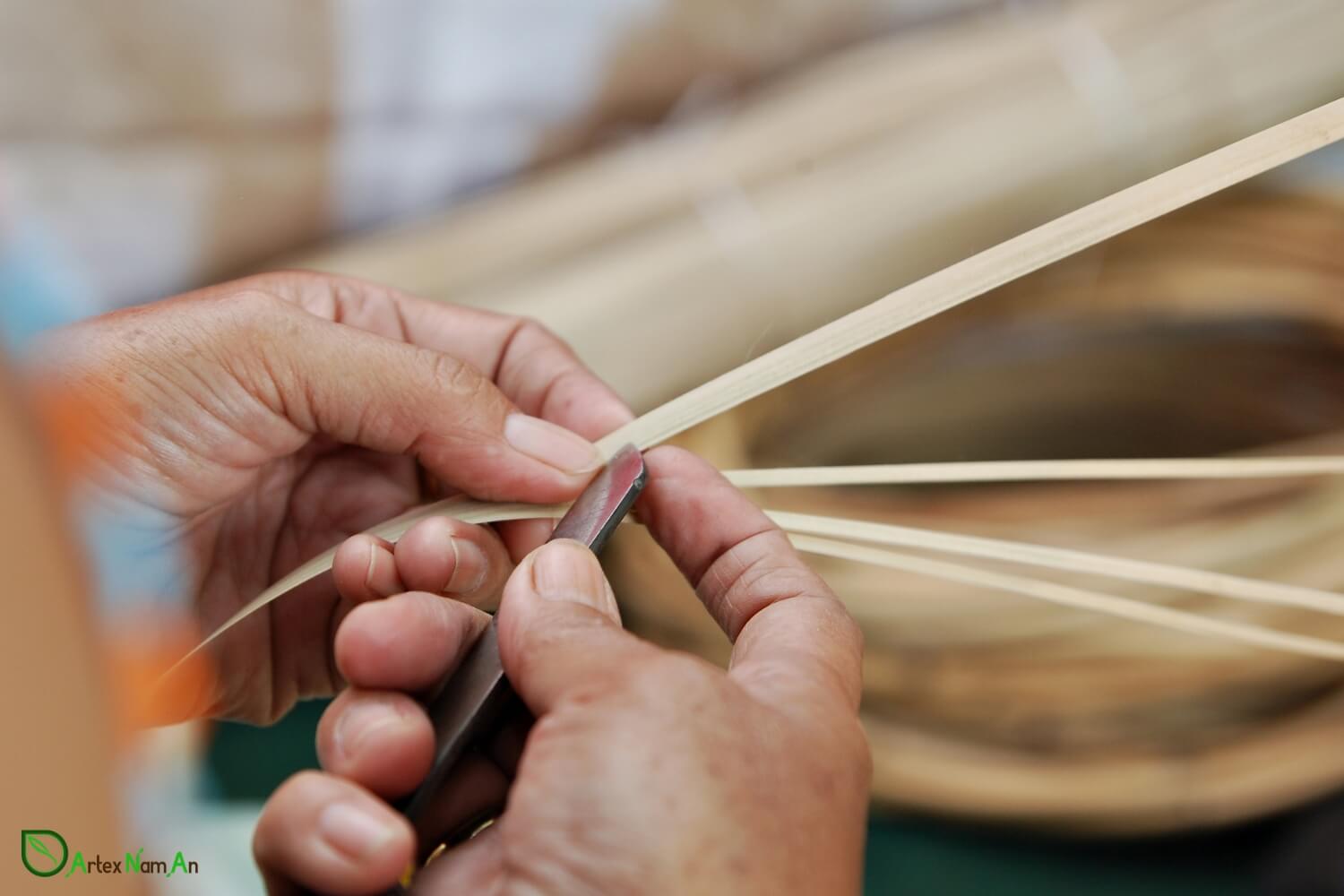
Bamboo Basket Production
Always split down the centre rather than shaving a strip off the side. Centre splits follow the fibre and stay even. Side splits wander out through the wall within a few centimetres, every single time. If a split does start running off course, bend the thicker half gently and it will pull back toward the middle.
Step 2: Peel, Shave, and Soak the Strips
Each strip now has a hard glossy green skin outside and softer pale flesh inside. Start a separation at one end and pull the strip past a knife held still, rather than pushing the knife along the strip. The skin is the strong, good looking part and is what you want visible on the finished basket. Shave each strip down to one or two millimetres and scrape the node ridges flat, because a node left standing proud refuses to bend and shows up as a lump in the weave. Sort the strips into rough width groups, since mismatched widths are the main reason a beginner weave looks uneven, then soak everything for twenty minutes so it bends without cracking. If you want the basket to last years rather than a season, boil the strips for an hour in water with borax at this point, which drives out the starch that attracts insects and is the one real weakness of bamboo as a material.
Step 3: Weave the Base Flat
Lay eight strips side by side on the table running left to right, with a small gap between each, then weave eight more through them at right angles, over one and under one, alternating the starting position on each new strip so the checkerboard appears. Push each new strip tight against the last. You should end with a woven square in the centre and sixteen loose ends radiating outward in four directions. Square it up and press it flat on the table. Never build the base in your hands, because one assembled in the air always comes out domed, and a domed base makes a basket that rocks whenever you set it down. The flat panel is worth practising on its own, because with a shallow edge instead of tall sides it is already a serving tray, which is the same construction behind bamboo serving trays wholesale ranges.
Step 4: Raise the Sides and Weave the Walls
Soak the loose ends again if they have dried, then bend every one upward at the edge of the base, creasing them firmly rather than letting them curve gently. That single crease is what stops the basket leaning three rows later. Tie string loosely around the uprights to hold them vertical while you start, and cut it off at the end. Now weave a long thin strip horizontally around them, over one and under one, overlapping each new strip behind an upright by four or five centimetres so the join hides. With an even number of uprights the pattern stacks on itself instead of spiralling, so add one extra upright anywhere in the circle. Keep the tension identical on every upright and look straight down into the basket every few rows, because a circle that has drifted oval is easy to correct at row four and impossible at row fifteen. Flare the walls outward and you get a basket. Take them straight up from a square base instead and you have a box, which is all a bamboo box wholesale item really is.
Step 5: Fold, Tuck, and Lash the Rim
Weave up to the height you want, soak the tops of the uprights thoroughly, then bend each one over and tuck the end down into the weave alongside its neighbour. Trim the ends inside at an angle so nothing catches a hand reaching in. Finally, sandwich the folded top edge between two thicker strips, one inside and one outside, and lash them together with a thin strip of bamboo or a length of rattan wound through the weave. The rim is not decoration. It carries the load whenever the basket is lifted and it is what stops the whole weave unravelling. Soak the lashing material first so it tightens slightly as it dries. It is the difference between a basket that lasts a year and one that lasts twenty, and it is the first thing a buyer picks up and turns over.
From One Basket to a Container Load
Making one teaches you why handwoven goods cost what they do. It also exposes the problem scale creates: two baskets woven by the same person on the same day will differ slightly, and a retail buyer receiving three hundred expects them to nest, stack, and match. That expectation is the whole reason bamboo baskets wholesale orders get specified in writing rather than agreed from a photograph.
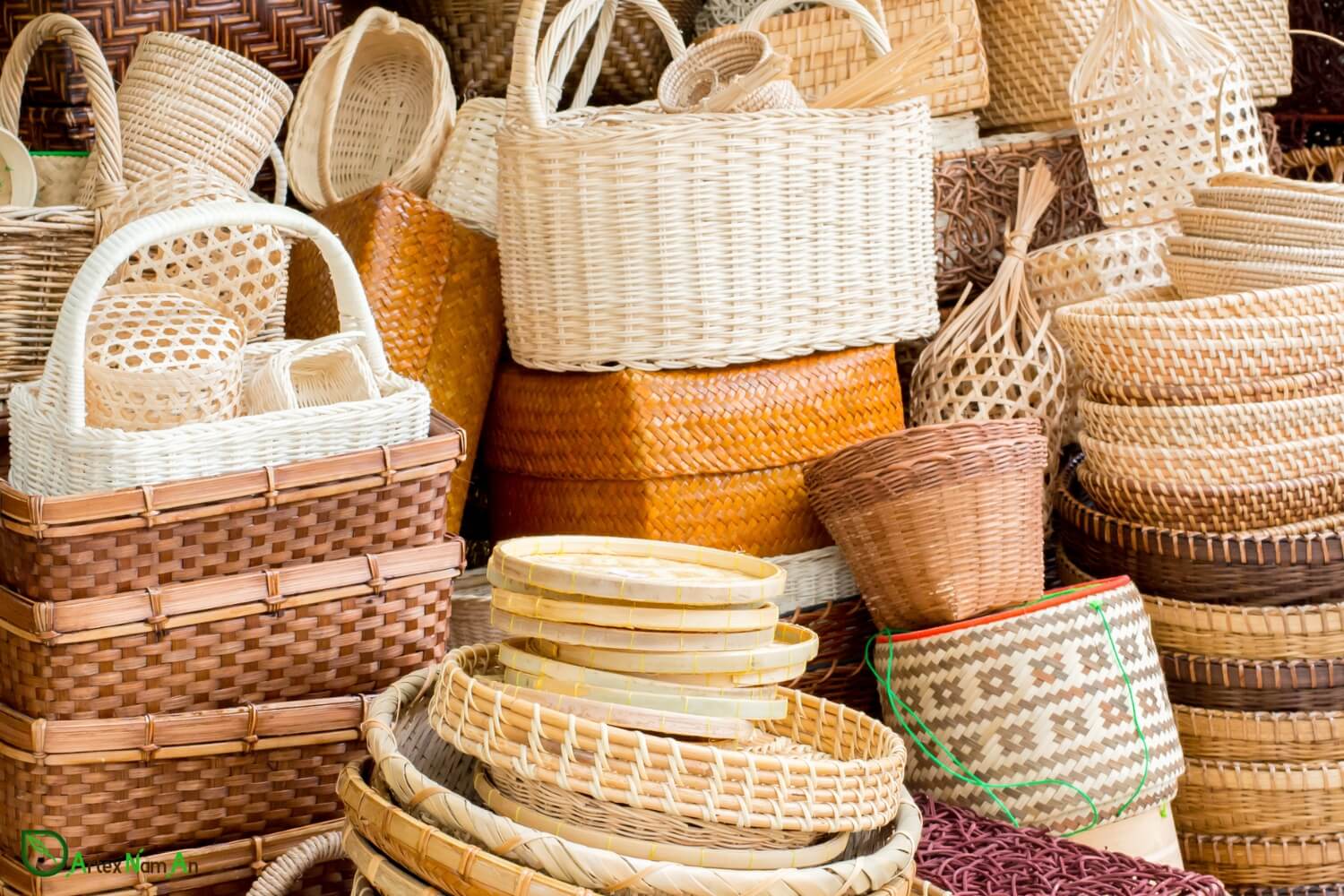
Bamboo basket wholesale in Vietnam
That consistency is a production discipline rather than a craft skill. Strip width gets sized on a machine instead of by eye, moisture content is measured before packing so baskets do not loosen after shipping to a dry heated country, and treatment is documented for customs rather than simply done. Those are the practical reasons brands buy through an established handicraft manufacturer rather than direct from a village workshop. It is also why a bamboo tray wholesale programme and a basket programme almost always run through the same factory, since the splitting, the treatment, and the moisture control behind them are identical.
Conclusion
Getting how to make bamboo basket weaving right is five steps and one rule. Cut and split the pole from the centre outward, peel and shave the strips and soak them, weave a flat base, crease the uprights and weave the walls, then fold, tuck, and lash the rim. The rule is to keep everything damp and to build the base flat on the table rather than in your hands. Your first will be lopsided. Your third will not.
If you have made one and now need a few thousand that match, Artex Nam An weaves bamboo, rattan, seagrass, and water hyacinth for retail and hospitality buyers worldwide. See how we prepare material on our production page, browse the range in our product catalogue, then send us a drawing or even a photograph and we will come back with a sample plan and a price.
You may also be interested in
Wicker Basket Suppliers in Vietnam for Wholesale and OEM Projects
Read more...Jun
The Growing Demand for Sustainable Rattan Placemats Bulk in Global Markets
Read more...Jul
What Are Picnic Baskets Made Of? From Willow Hampers to Foil Lined Coolers
Read more...Sep
The Complete Guide to Sourcing Sustainable Bamboo Gift Boxes Wholesale
Read more...Jul
Sustainable Wicker Placemats Bulk for Retail and Hospitality Markets
Read more...Jul
What to Look for in Cane Furniture Manufacturers: A Buyer’s Guide
Read more...Aug