


No products in the cart.
Industry News
What Are Woven Baskets Made Of?
31
Aug
Aug
Baskets are older than pottery and considerably older than writing. Every culture that had flexible plants and something to carry arrived at the same idea independently, which means the honest answer to what are woven baskets made of is: whatever grew nearby and would bend without breaking. That sounds like a dodge, but it is actually the most useful way to understand the subject, because the plant part a basket is made from predicts almost everything about how it behaves in a house.
Every Basket Starts as a Plant Part
Sorting materials by which bit of the plant they came from is more useful than sorting them by name, because the plant part determines strength, flexibility, and how the fibre ages.
Stems and Canes
The strongest group. Rattan is a climbing palm with a solid core that steams into tight curves and holds them. Willow rods are coppiced annually and used green with the bark on or stripped and dried. Bamboo is split from a hollow culm into flat strips. All three carry real weight and hold a shape unsupported, which is why anything expected to be structural is made from one of them. The botanical detail behind the most commercially important of them is set out under rattan.
Grasses and Leaves
Softer, cheaper, and enormously varied. Seagrass is harvested from coastal wetlands and twisted into cord. Water hyacinth is an invasive floating weed, dried and rolled into thick rope. Palm leaf, raffia, sisal, and lauhala all fall here too. These fibres produce soft sided baskets with a lot of texture and very little rigidity, so anything that must keep its shape when empty needs an internal frame.
Bark, Root, and Splint
The oldest group and the least commercially common today. Birch bark, cedar root, black ash splint, and oak splint were the backbone of basketry across northern Europe and North America. They are prepared by pounding or splitting along growth rings, they last extraordinarily well, and they are now largely the preserve of traditional makers rather than production supply, mostly because preparing them is slow and cannot be mechanised easily.
The Same Question, Answered Differently Around the World
Geography wrote the answer before anybody chose. Southeast Asia had rattan, bamboo, seagrass, and water hyacinth in abundance, so that is what the region weaves, and it is why so much of the world’s basket supply still comes from Vietnam, Indonesia, and the Philippines. Europe had willow growing in wet ground along rivers, so European basketry is a willow tradition, from French oyster baskets to English hampers.
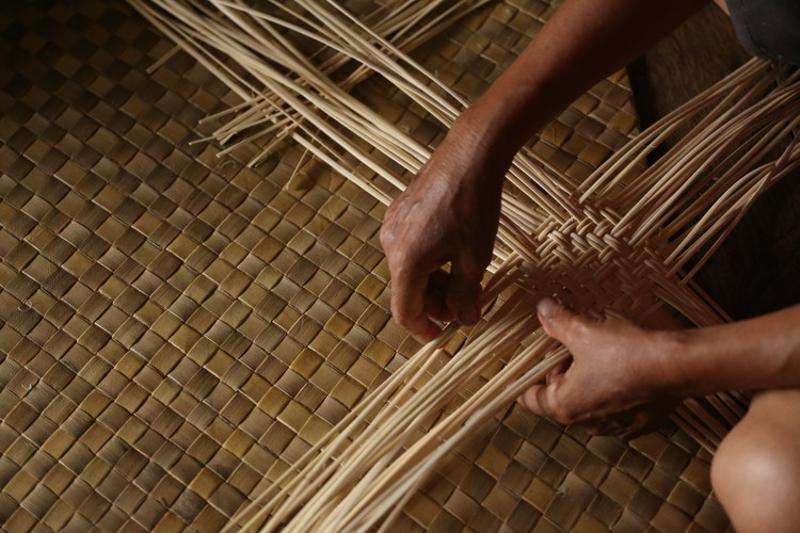
Rattan Furniture Maker
North American basketry ran on black ash splint, sweetgrass, and cedar root, worked by techniques that produce a very different surface from anything woven in Asia. Africa produced some of the finest coiled work in the world in palm leaf, sisal, and grass bundles, often stitched so tightly the finished basket holds water. Japan turned bamboo splitting into something close to a fine art, with strips shaved to fractions of a millimetre and weaves that are structural and decorative at once.
None of these traditions is a museum piece. Walk through any homeware department and you are looking at descendants of all of them, usually with the origin unmentioned on the label.
Materials That Are Not Plants at All
Wire and Metal
Woven wire baskets borrow the technique entirely and swap the material. They are rigid, washable, and completely immune to damp, which makes them the sensible answer for bathrooms, commercial kitchens, and anywhere a natural fibre would eventually turn mouldy. What they cannot do is soften a room, which is usually the reason someone wanted a basket in the first place.
Paper Rope, Plastic, and Recycled Fibre
Paper rope, made from twisted recycled paper often wrapped over a wire core, is light, inexpensive, and takes dye far more consistently than any natural fibre. Synthetic resin fibre, the material behind most all weather outdoor furniture, is essentially plastic extruded to look like rattan and is genuinely weatherproof. Recycled plastic strapping and rolled magazine paper both turn up in craft and fair trade production. None of these have the strength of stem fibres, but for colour led ranges and outdoor use they solve problems natural material cannot.
How the Material Shows Up in the Finished Basket
You can usually identify the fibre by hand before reading a label. Rattan feels dense and slightly waxy, with a visible solid core where a strand is cut. Bamboo is unmistakably flat and has a glossy skin on one face. Willow has a faintly irregular taper along each rod and small bud scars. Seagrass has a twisted cord structure and a green to honey colour that fades unevenly toward straw as it ages. Water hyacinth is chunkier, matte, and paler, with a slightly spongy feel. Paper rope is perfectly regular, which is the giveaway, since nothing that grew is ever quite that consistent.
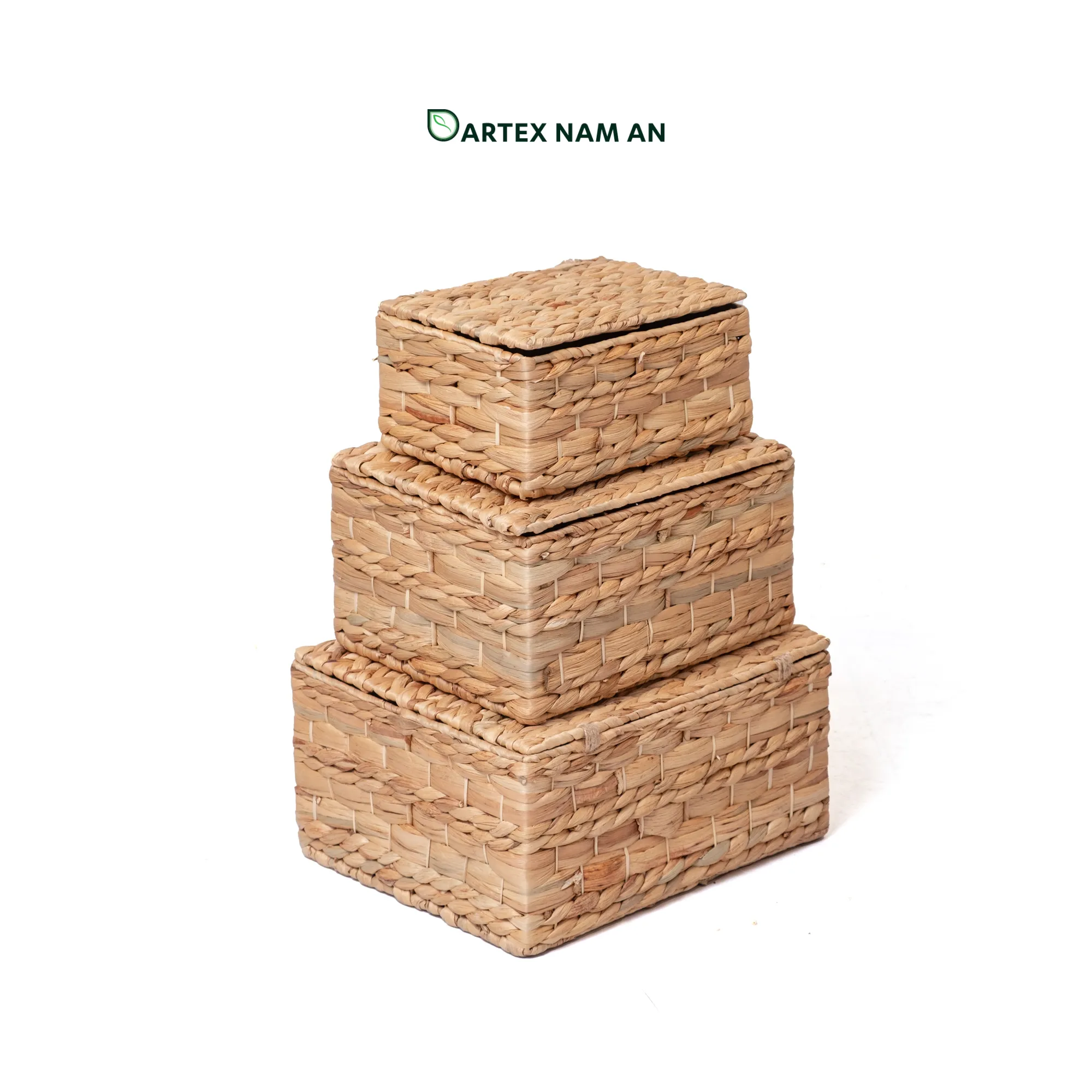
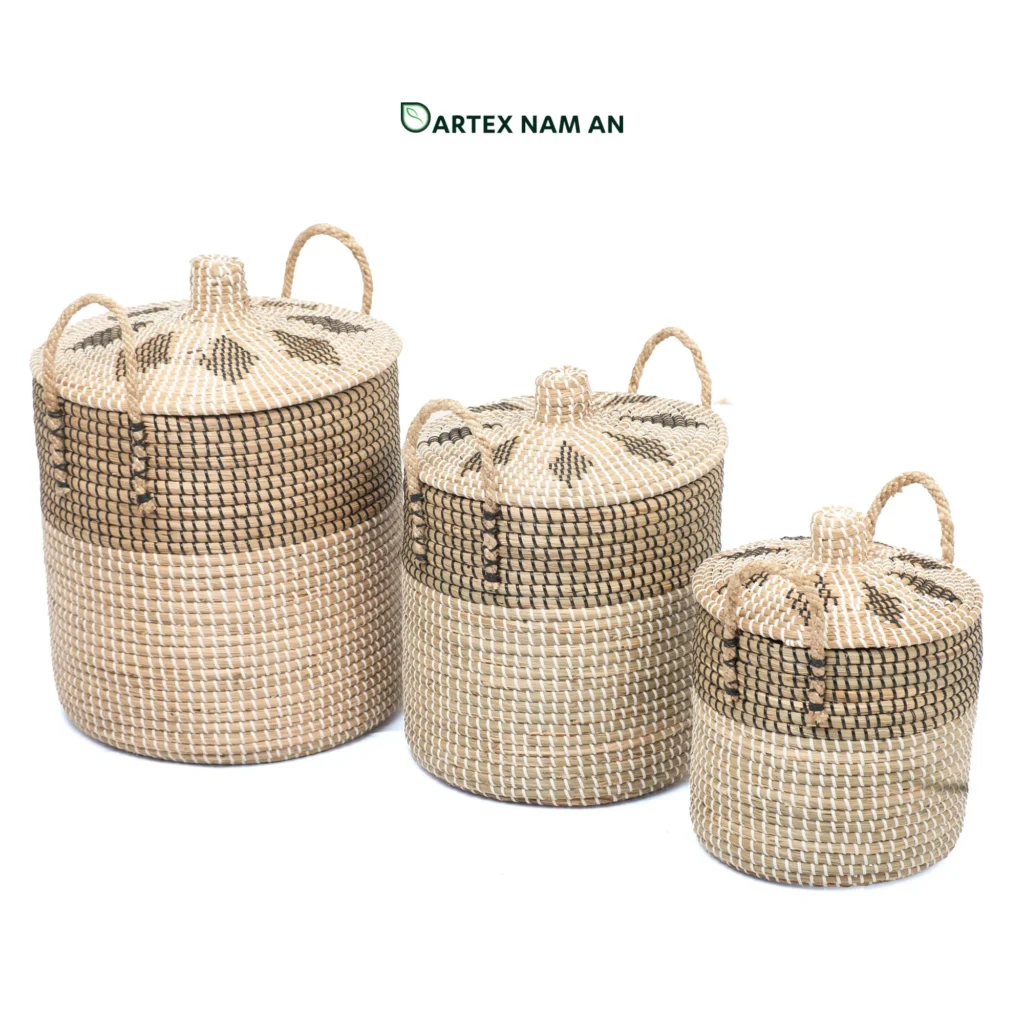
Wholesale Storage basket set of 3
Those differences translate directly into behaviour. Stem fibres hold shape and carry weight. Grass fibres bring texture and warmth but need a frame. Anything from a wetland plant will mark if it stays damp. And regularity, the thing that looks like quality in a photograph, is actually the sign of a manufactured fibre rather than a natural one.
Choosing a Material for a Specific Job
The useful version of this question is not what baskets are made of in general but what a particular basket should be made of.
Storage That Has to Hold Its Shape
Shelf and cube storage needs to stand up empty and stack without deforming. That means rattan, willow, or a framed construction in a softer fibre. An unframed seagrass cube looks excellent in a product photograph and collapses inward within a year of real use, which is a common and avoidable disappointment in storage basket wholesale ranges.
Laundry and Damp Rooms
Damp is the deciding factor. Willow historically did this job and does it well. Rattan is acceptable with a proper finish. Seagrass and water hyacinth will spot and eventually grow mould in a poorly ventilated bathroom, so if a range is going into that use it needs either a liner or a different fibre. The material tradeoffs specific to that category are covered in laundry basket wholesale.
Display, Gifting, and Seasonal Ranges
Here appearance and cost lead, because the product does not need to survive a decade of loading. Water hyacinth, seagrass, and paper rope all work, and paper rope wins outright where a range needs several colourways that match exactly. Sourcing considerations for the natural end of this are in seagrass basket wholesale and willow baskets wholesale.
What Changes When You Buy Two Thousand
At volume the material question stops being academic and starts being the largest line in the quotation.
Natural Fibre Varies, and That Has to Be Managed
Rattan cut in different seasons differs in colour. Seagrass harvested from different areas differs in tone. A retail buyer receiving three hundred baskets expects them to look like a set, so the supplier has to sort and batch material rather than simply weaving whatever arrives. Ask how colour matching is handled across an order and whether the whole quantity is woven from one material lot. Suppliers who have not thought about it will say the variation is natural, which is true and also not an answer.
Moisture, Treatment, and the Container Journey
A basket woven in a humid climate and shipped to a dry heated house in winter will lose moisture, and if it left the factory too wet it can loosen, crack, or grow mould inside a sealed container on the way. Moisture content at packing and anti mould treatment are both specifiable and both worth specifying.
Conclusion
Woven baskets are made from stems, grasses, leaves, bark, roots, and increasingly from wire and recycled paper, and which one you are holding was decided by whatever grew near the people who first made that shape. The practical takeaway is simpler than the botany: stems carry weight, grasses bring texture, wetland fibres dislike damp, and manufactured fibres win on colour consistency. Decide what the object has to survive, pick the fibre that survives it, and the rest of the decision looks after itself.
Artex Nam An is a Vietnamese handicraft manufacturer weaving rattan, bamboo, seagrass, water hyacinth, and paper rope for retail, gifting, and hospitality buyers, with fibre, frame, moisture, and treatment written into every specification. Browse the current range in our product catalogue, see how material is selected and prepared on our materials and production page, then tell us what the basket has to do and we will recommend the fibre before we quote the price.
You may also be interested in
How Artex Nam An Joined Hands With BEBE BASK To Craft Safer, Stronger, And More Sustainable Nursery Products
Read more...Aug
Top 9 Weaving Styles For Water Hyacinth Baskets Wholesale
Read more...Mar
Wholesale Hanging Baskets: How to Choose a Supplier You Can Rely On
Read more...Aug
Comfort Home 2022 – All-new Wicker Collection of Storage Baskets & Planters
Read more...Jul
Water Hyacinth Vs Seagrass: Key Differences You Should Know
Read more...May
Who Makes the Best Wicker Furniture? The Brands, the Factories and How to Judge a Piece Yourself
Read more...Sep