




No products in the cart.
Industry News
Bulk Hanging Baskets: The Economics of Ordering at Volume
23
Aug
Aug
There is a moment in most sourcing conversations where the quoted unit price stops being the useful number. Two suppliers offer hanging baskets at $4.10 and $3.85, the cheaper one looks obviously better, and then the freight invoice arrives and reverses the entire comparison.
Bulk hanging baskets are unusually prone to this, because they are light, awkwardly shaped, and full of air. Understanding how volume purchasing actually works in this category, and where the real costs sit, is worth considerably more than negotiating another few cents off the unit price.
Why Handwoven Volume Behaves Differently
Why Scale Does Not Cut Labour
In most manufacturing, scale reduces cost because fixed setup costs spread across more units. Injection moulding is the clearest example, where the mould is expensive and every subsequent unit is cheap. Handwoven baskets have almost no fixed setup cost. There is no tooling, no mould, no production line to reconfigure. What there is instead is labour, and labour scales close to linearly. A weaver takes roughly the same time on the thousandth basket as on the first.
How Far Volume Discounts Actually Go
The practical consequence is that price breaks in this category are real but modest. Moving from five hundred pieces to five thousand might reduce your unit price by ten to fifteen percent, not by half. Those savings come from better raw material purchasing, more efficient production scheduling, and reduced administrative overhead per unit rather than from any dramatic efficiency in the weaving itself. A supplier promising enormous volume discounts is usually signalling that they intend to loosen the weave or thin the frame, because that is the only remaining lever. Where volume genuinely transforms your economics is in freight and in the terms you can negotiate, which is where attention belongs.
Minimum Order Quantities and How They Are Structured
Direct factory relationships in this category typically start around three hundred to five hundred pieces per design and colour combination. That last phrase carries most of the weight. Two thousand baskets across one design in one finish is a straightforward order. Two thousand baskets across four designs in three finishes is twelve separate production runs of under two hundred pieces each, and most factories will either decline it or price it as twelve small orders. Trading companies solve this by consolidating your requirement with other buyers, which lowers the entry point but costs margin and removes your visibility into who is actually weaving your product. For a first small trial that tradeoff can be sensible. For an established programme it rarely is.
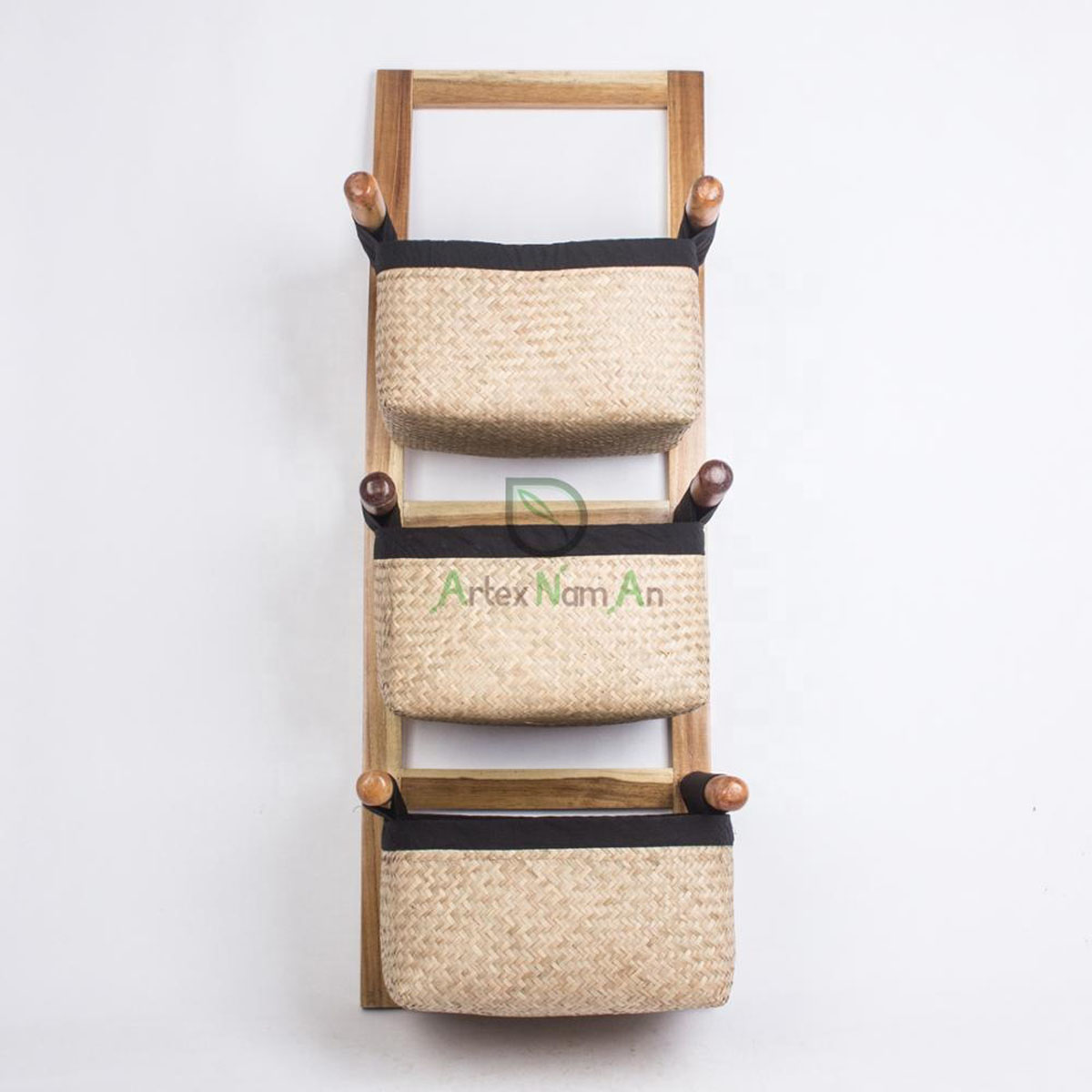
Woven Seagrass Hanging Hamper Storage Basket – Artex Nam An
The most effective way to reach a meaningful minimum without fragmenting your range is to concentrate variation where it is cheap and restrain it where it is expensive. Size variation within a single design and finish is inexpensive, since the weaver is doing the same work at a different scale. Finish variation is moderately expensive. Entirely separate designs are the costly kind of variation. Buyers who understand this build ranges that look broad on the shelf while remaining concentrated in production.
Cubic Volume Is the Number That Matters
Sea freight is charged on the space your goods occupy, not their weight. Hanging baskets weigh very little and occupy a great deal of space, which means shipping can easily represent twenty to thirty percent of your landed cost, and occasionally more on lower priced lines. This makes nesting the single most valuable design decision available to you. A set of three baskets designed to nest can occupy barely more volume than one basket shipped alone. A set of three designed without that consideration occupies three times the space and costs three times as much to move. The design difference is often trivial, amounting to a slight taper on the side wall, but nobody applies it unless the buyer asks.
Before you compare quotations, get precise answers from each supplier on carton dimensions, how many pieces fit per carton, cubic metres per carton, and how many cartons load into a twenty foot container and a forty foot high cube. A supplier who produces these figures immediately has shipped internationally many times. A supplier who has to go and find out has not.
Run the arithmetic yourself. Take the unit price, add the freight cost per unit derived from your cubic metre figures, then add duty, customs clearance, and inland delivery to your warehouse. That total is your landed cost, and it is the only figure worth comparing between suppliers. The basket that was twenty five cents cheaper frequently loses this comparison outright once it turns out to ship at double the volume. Buyers running several categories at once should also consider consolidating. Filling the remaining space in a container with flat packing goods such as wholesale woven baskets or placemats spreads the freight cost across more sellable value and improves the economics of every line in the container.
Packaging Decisions That Protect the Investment
Controlling Moisture in Transit
Bulk shipments fail in predictable ways, and nearly all of them are preventable for a few cents per unit. Moisture is the principal enemy. Natural fibres shipped at excessive moisture content will develop mould inside a sealed container crossing tropical latitudes, and an entire order can be rejected on arrival. Specify a kiln dried moisture content between twelve and fourteen percent, ask to see the readings, and insist on polybagging with desiccant sachets inside every export carton. This is the cheapest insurance available in the whole transaction.
Protecting Against Crushing
Crushing is the second issue. Baskets are strong vertically and weak laterally, so stacking configuration matters. Ask how cartons are palletised and whether internal dividers are used on nested sets. A carton that arrives compressed produces baskets that no longer sit straight. The cords and hanging hardware also deserve attention in packing. Loose cords tangle in transit and add unpacking labour at your end, which is a real cost when it is multiplied across several thousand units. Ask for them to be bundled or tucked inside the basket rather than left loose.
Cash Flow, Terms, and Risk
Volume ordering concentrates capital. A large order placed six months before your selling season ties up cash and warehouse space for that entire period, and that carrying cost is real even though it appears on no invoice. Standard terms in this trade run to a thirty percent deposit with the balance paid against shipping documents. Established relationships sometimes improve on that. Suppliers requesting full payment upfront on a first order should prompt caution, and payment routed to personal accounts or third countries should stop the conversation entirely.
Splitting a large annual requirement across two shipments is often worth the marginally higher freight rate. It smooths cash flow, reduces the consequence of a forecasting error, and gives you a chance to correct any quality issue before the second half is produced. Many buyers discover only after the fact that this option was available to them. Working consistently with the same wicker basket suppliers across several seasons tends to improve terms naturally, because a factory prices risk into every quotation and a proven buyer represents less of it.
Cut Your Landed Cost, Not Your Weave
The real savings in this category sit in nesting, carton efficiency, and container planning rather than in another few cents off the unit price. Artex Nam An will give you carton dimensions, pieces per carton, and cubic metres per container before you commit, and will design nesting into the product where it pays. Ask Artex Nam An for a landed cost breakdown alongside your quotation.
Conclusion
Bulk hanging baskets reward buyers who look past the unit price. The savings available from volume negotiation in a handwoven category are modest and finite, while the savings available from intelligent nesting, container consolidation, and disciplined range concentration are substantial.
Calculate landed cost before comparing anything, specify moisture control and packaging in writing, and structure your minimum order around fewer variants ordered deeper rather than many ordered thinly. Get those right and the difference between a good quotation and a mediocre one becomes far less important than it first appeared.
Read more: What to Look for in Cane Furniture Manufacturers: A Buyer’s Guide
You may also be interested in
Partnering With a Direct Factory for Premium Bamboo Tray Wholesale
Read more...Jun
Top Differences Between Cane vs Bamboo In Home Industry
Read more...Jul
Rattan Garden Furniture Wholesale: The Complete Sourcing Guide for Retailers and Wholesalers
Read more...Jul
How to Source Export Standard Bamboo Baskets Wholesale for Global Retail
Read more...Jun
Comfort Home 2022 – All-new Wicker Collection of Storage Baskets & Planters
Read more...Jul
Rattan vs Wicker, Cane, Willow: Here is the difference between 4 popular terms
Read more...Nov