



No products in the cart.
Industry News
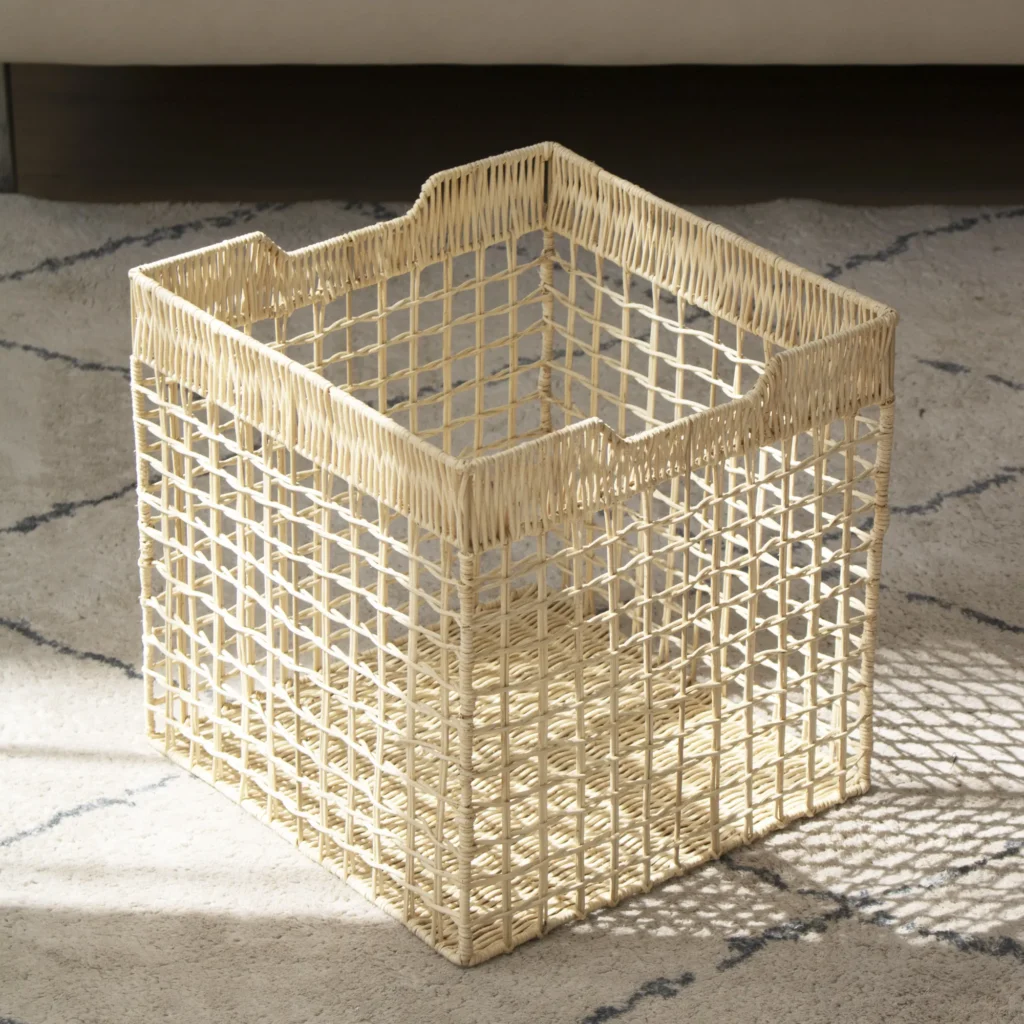
How to Make Rattan Basket Weaving: A Five Step Guide
07
Sep
Sep
Rattan is the most forgiving material a beginner can weave with, and it is also the one most beginners give up on, for the same reason: they start dry. Dry rattan cracks at the first tight bend, the base refuses to sit flat, and by the third row the whole thing looks like a bird’s nest. Soak it properly and the same reed bends like cooked pasta, holds a curve, and dries hard into whatever shape you gave it. Knowing how to make rattan basket work is about ninety percent water and ten percent hands, and the five steps below keep the proportion honest.
What You Need Before You Start Weaving
Rattan Reed in Two Thicknesses
Buy round reed in two sizes: something around 4 to 5 millimetres for the stakes that form the skeleton, and 2 to 3 millimetres for the weavers that go around them. Reed is the split inner core of the rattan palm, sold in coils by diameter, and it is the standard craft material precisely because it is even, predictable, and cheap. The plant itself is a climbing palm, and the botany of Calamus explains why the core is solid and bends without splitting, which bamboo does not.
Tools That Cost Less Than the Reed
A bucket of warm water, a pair of side cutters, a bodkin or a blunt awl for opening gaps in the weave, a tape measure, and clothes pegs to hold things while they dry. That is all. A first basket needs nothing that costs more than a few dollars.
How to Make Rattan Basket Weaving Work in Five Steps
Step 1: Soak and Keep Soaking
Coil the reed loosely and submerge it in warm water for twenty to thirty minutes, until it feels like cooked spaghetti rather than string. Soak only what you will use in the next half hour, because reed left in water for hours goes grey and furry and never dries to a clean finish. Wrap the working length in a damp towel between rows, and put any piece that has stiffened back in the bucket for five minutes rather than forcing it. Almost every crack in a beginner’s basket happened at a bend made with reed that had dried.
Step 2: Lay Out the Base Flat on the Table
Cut eight stakes of the thicker reed, each about 45 centimetres for a small basket. Lay four across the other four in a cross, centred. Take a long thin weaver, fold it in half, loop it around one group of four, and begin pairing: the two ends of the weaver cross each other between each group of stakes, over and under, locking the cross together. After two full rounds, split the groups into pairs, then after two more rounds into single stakes, spreading them out evenly like the spokes of a wheel. Keep the base flat on the table as you go. A base built in your hands always comes out domed, and a domed base rocks forever.
Step 3: Turn the Corner
When the base reaches the diameter you want, stop and check it lies flat. Then soak the stakes again and crease each one sharply upward at the edge of the base, squeezing the bend with pliers or a thumbnail so it kinks rather than curves. This is the step that decides whether the basket stands straight or leans, and the mistake is nearly always a soft rounded bend instead of a definite crease. Tie the stakes loosely together at the top with string to hold them upright while you start the walls.
Step 4: Weave the Walls
Take a thin weaver and go around the uprights, over one and under one. With an even number of stakes the pattern will stack on itself instead of spiralling, so either work with an odd number or add one extra stake now. Push each row down snugly against the last with your fingers, keep the tension the same on every stake, and when a weaver runs out, overlap the new one behind a stake by a few centimetres so the join disappears. Look straight down into the basket every few rows. An oval that has crept in is easy to push round at row four and impossible at row fifteen. Flare the stakes slightly outward as you climb for a bowl, keep them vertical for a straight sided basket.
Step 5: Finish the Rim
Weave to the height you want, then soak the tops of the stakes thoroughly. Bend each stake down and to the right, tucking it behind the next stake and down into the weave, all the way round, threading the last few through the loops made by the first. Trim the ends inside at an angle so nothing catches a hand. For a stronger rim, lash a thicker piece of reed around the top edge with a thin weaver. Let the finished basket dry for a day somewhere airy, and it will stiffen into the shape you gave it.
The Three Things That Go Wrong on a First Basket
Three problems account for nearly every disappointing first basket, and all three have a five second fix. Cracking at bends means the reed was too dry. Soak longer and soak again during work. Walls that lean or splay unevenly mean the stakes were curved upward instead of creased, or the tension changed halfway round.
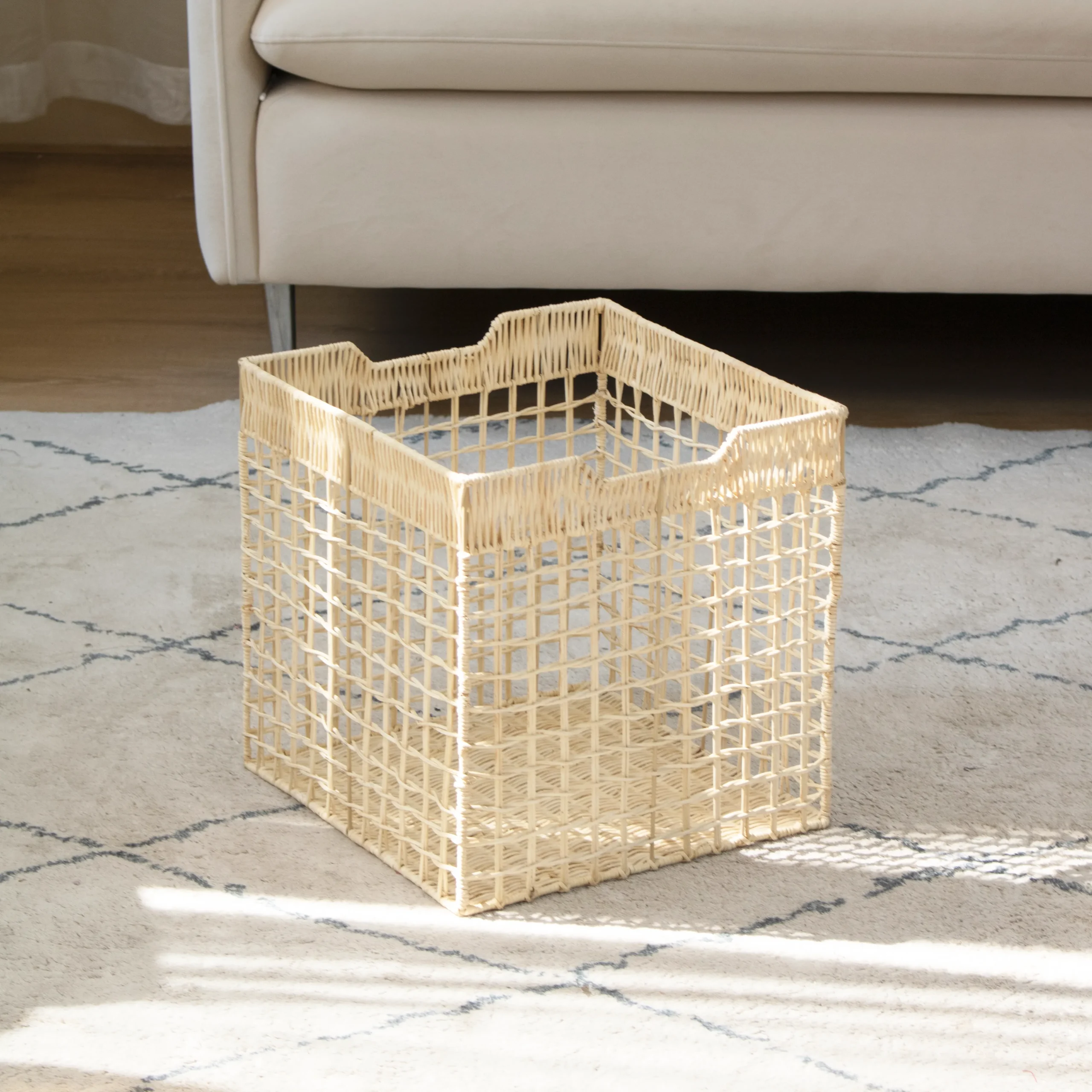
Rattan basket
Undo two rows and redo them; it is quicker than living with it. A base that rocks means it was built in the air. Press it under a board overnight while still damp, and build the next one on the table. None of these are talent problems. They are water and patience problems, and the second basket is always dramatically better than the first. If bamboo appeals more, the flat strip version of the same craft is a different discipline, and the splitting is the hard part rather than the weaving, which is why the steps for how to make bamboo basket work start with a knife rather than a bucket.
Weaves and Handles and Shapes
Once the round bowl works, the same five steps produce almost every basket shape, and the variations are worth trying in order.
Try Other Weave Patterns Such as Pairing or Waling
Pairing, where two weavers twist around each other between stakes, is stronger than plain over and under and makes a firmer wall. Three rod waling, using three weavers at once, produces the thick decorative bands seen on traditional work and is the usual choice for the row just above the base and just below the rim. Both are easier than they look once the basic weave is fluent.
Add a Handle That Actually Carries Weight
Push a thick soaked rod down into the weave on opposite sides, bend it over, and wrap it tightly with a thin weaver. The wrapping is what takes the load, so it needs to be tight and continuous. A handle is the difference between a decorative bowl and a basket somebody uses, which is the same difference that decides how to make a woven basket that gets used rather than admired.
Work Wider for Trays or Taller
Fewer rows of wall and more base give a tray. More stakes and a taller wall give a laundry basket. The construction never changes, only the proportions, which is why a single rattan workshop can produce the entire span from bread basket to hamper on the same bench, and why a wholesale rattan baskets range usually comes from one floor.
From One Basket to Rattan Basket Wholesale Orders That All Look the Same
Making one basket teaches you why a handwoven one costs what it does. A competent weaver makes a simple rattan storage basket in about forty minutes, after years of practice on that one shape. It also shows you the problem scale creates: two baskets by the same person on the same afternoon differ slightly, and a retail buyer receiving three hundred expects them to nest and match.
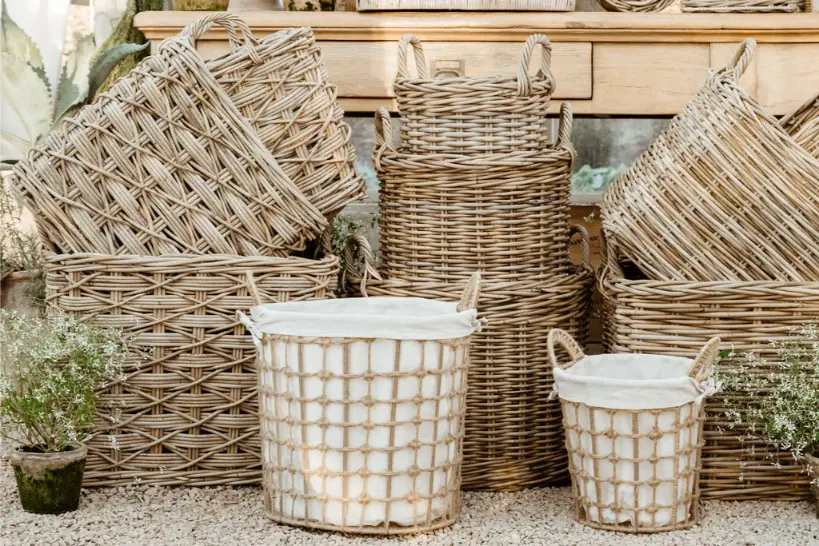
Rattan Basket Wholesale – Artex Nam An
That consistency is a production discipline rather than a craft one. Reed is sorted by diameter and colour lot rather than by eye, moisture is measured before packing so baskets do not loosen after shipping to a dry heated country, and frames and finishes are written into the order. Those are the reasons a brand buys through an established handicraft manufacturer rather than a collective of individual weavers. It is also why buyers ordering rattan basket wholesale specify the weave, the stake gauge, and the rim finish rather than sending a photograph, and why a good factory will ask for all three before quoting.
Conclusion
How to make rattan basket weaving succeed comes down to five steps and one rule. Soak the reed until it bends like pasta and keep it damp throughout. Build the base flat on the table. Crease the stakes upward instead of curving them. Weave the walls with even tension and an odd number of stakes. Fold and tuck the rim, then let it dry into shape. The rule is water. Nearly every failure is a bend made with dry reed, and nearly every success is a bucket refilled one more time than felt necessary.
If you have made one and now need a few thousand that match, Artex Nam An weaves rattan, seagrass, bamboo, and water hyacinth for retail and hospitality buyers worldwide. See how we prepare and sort material on our production page, or send us a photograph or a sketch with a target quantity and we will come back with a sample plan and a price.
Read more: How To Make A Woven Basket: From First Coil To A Basket That Holds Its Shape
You may also be interested in
Handicraft Business Ideas: Eleven Products and Models That Can Start Small and Grow
Read more...Sep
How to Make Table Placemats: Four Methods, One Set of Rules That Matter
Read more...Aug
How to Start Handicraft Business: From a Single Product to a Container
Read more...Sep
Spun Bamboo: How To Make Wholesale Bamboo Fiber Salad Tableware
Read more...Sep
Choosing the Right Handicraft Manufacturer: Quality, Ethics, and Global Reach
Read more...May
Wholesale Hanging Baskets: How to Choose a Supplier You Can Rely On
Read more...Aug